O.K, DL’s story time; get comfortable and let me paint you a picture.
It’s contract renewal month. Your client’s procurement team is sat in a room with spreadsheets from three competing FM providers. Everyone’s offering roughly the same services, roughly the same SLAs, roughly the same pricing. The conversation in each presentation session inevitably turns to: “What makes you different?“
And here’s where it gets interesting.
One provider hits cmd+tab and flicks away from their presentation to a live dashboard. Real-time energy consumption across the client’s portfolio. Predictive maintenance alerts. Cleaning compliance rates by site. KPI adherence. Carbon footprint tracking against their Net Zero targets. All of it beautifully visualised, all of it accessible to the client 24/7 through their own branded portal.
The other two providers? They’ve pull up quarterly PDF report example (2020 style QBR anyone? 🥴)
Who do you think is walking away with that contract?
The Shift That's Already Happening
If you’ve been paying attention to what your clients are asking for over the last 18 months, you’ll have noticed something. The questions have changed… a lot!
It used to be: “Can you show us your KPIs?”
Now it’s: “Can we see our data? In real-time? On our own terms?” and “Can you show us how you’ll be working proactively to add value, and not just reporting what happened?”
This isn’t a nice-to-have anymore. It’s becoming table stakes for the larger contracts, and it’s trickling down fast. Clients don’t want to wait for your monthly report to find out that energy consumption spiked at one of their sites three weeks ago. They want to know now. They want to see patterns. They want to make decisions based on live information, not historical summaries that arrive too late to act on.
The FM providers who can offer this level of transparency and accessibility are going to win. Full stop. The new world is transparent partnering, not rear-view-mirror supplier/customer relationships.
We’re hearing from more and more clients that data transparency is now a top-three factor in selecting or retaining a service provider. The market is moving. Fast.
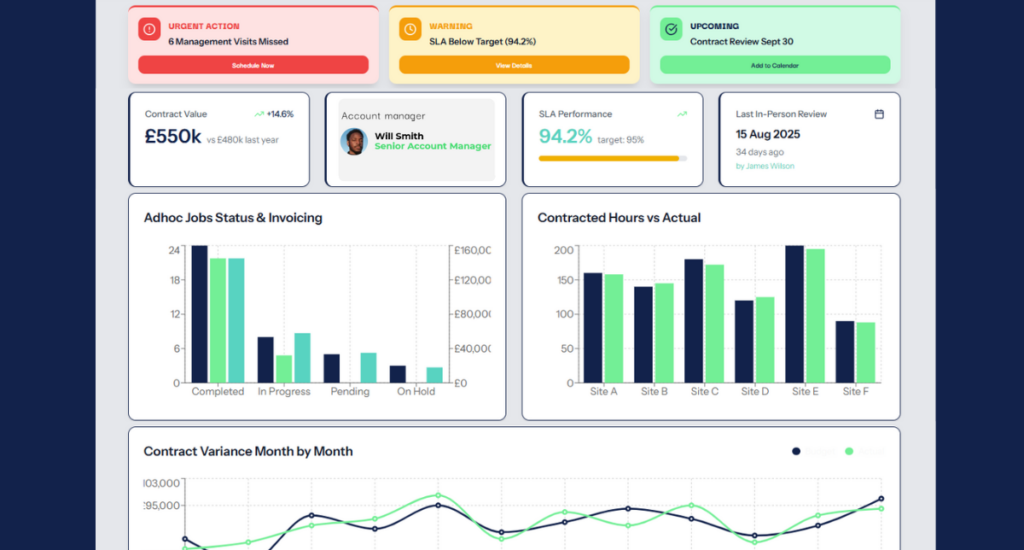
What Actually Is a Customer Analytics Portal?
Let’s be clear about what we’re talking about here, because the term gets thrown around a lot.
A customer analytics portal isn’t just a login page where your client can download the same reports you’ve been emailing them. That’s a document repository with extra steps.
A proper customer analytics portal gives your clients:
- Near real-time visibility into the services you're delivering across their estate
- Interactive dashboards they can filter, drill into, and explore on their own
- Benchmarking data so they can compare site performance across their portfolio
- Automated alerts when something needs attention
- Self-service reporting so they can pull what they need, when they need it
- ESG and sustainability tracking aligned to their corporate reporting requirements
It’s essentially giving your client a window into your operations, but a curated, intelligent window that tells a story about the value you’re delivering.
The best ones don’t just show data. They surface insights. They answer questions before the client even thinks to ask them.
Why This Is Going to Separate Winners from Losers
Here’s the uncomfortable truth for a lot of FM service providers: your actual service delivery might be excellent, but if your client can’t see that excellence, it doesn’t exist in their minds.
Perception is reality when it comes to contract retention.
Think about it from your client’s perspective. They’re under pressure from their own leadership to demonstrate value from every supplier relationship. They need to justify the FM spend at every budget review. They need data to support their own ESG reporting. They need evidence that the services they’re buying are actually being delivered to spec.
If you can give them that evidence‚ beautifully presented, always accessible, undeniably clear – you become indispensable. You’re not just a vendor anymore. You’re a strategic partner who makes their job easier (and importantly, raises their profile)
And in an industry where the average contract retention sits at around 18 months right now, anything that extends that relationship is worth its weight in gold.
The maths is simple, really. Retaining an existing client costs a fraction of winning a new one. If a customer analytics portal helps you keep just one or two major contracts that might otherwise have gone to tender, the ROI is enormous.
But it goes beyond retention. The providers who nail this are going to win new business too, lots of it. Because when you can walk into a pitch and demonstrate the level of transparency and data maturity your competitors can only talk about, you haven’t moved the goal posts, you’re playing a different game entirely.
The Problem: Building One Is Brutally Hard
So, if customer analytics portals are so obviously valuable, why doesn’t every FM provider have one already?
Truth-bomb – because building one properly is an absolute nightmare for most organisations.
Let me walk you through what’s actually involved.
1. Data Integration
First, you need to pull data from every system you use to deliver services. Your CAFM system. Your HR and scheduling platforms. Your finance systems. Your subcontractor portals. Energy monitoring. IoT sensors. Access control. Health and safety. The list goes on.
Each of these systems speaks a different language. Different data formats. Different APIs (if they have APIs at all). Different update frequencies. Getting all of this data to flow into a single, coherent place is a massive engineering challenge.
Most FM providers we speak to have anywhere from 8 to 15 different operational systems. Connecting them all? That’s months of work, even for experienced data engineers, for the uninitiated – years.
2. Data Modelling
Once you’ve got the data flowing, you need to make sense of it. Raw data from these systems is, frankly, rubbish in its native form, usually. It needs to be cleaned, transformed, normalised, and modelledinto structures that actually support the kind of analysis and visualisation your clients want.
This requires a completely different skillset, data architects and analysts who understand both the technical side and the business context. These people are expensive and in very high demand.
3. Building the Actual Portal
Now you need to build the front-end that your clients will actually interact with. This isn’t just about making charts look pretty (though that matters). It’s about:
- User experience that makes complex data accessible to non-technical people
- Security and access controls so each client only sees their own data
- White-labelling capabilities so it feels like an extension of your brand
- Mobile responsiveness
- Performance optimisation so dashboards load quickly, even with large datasets
You’re essentially building a SaaS product. That’s not a small undertaking…
4. Ongoing Maintenance and Evolution
Here’s the bit that catches most people out. Building the portal is just the beginning. You then need to:
- Keep the data integrations running as source systems get updated
- Add new data sources as client requirements evolve
- Build new dashboards and reports for different client needs
- Maintain security certifications and compliance
- Provide support when things break
- Continuously improve based on user feedback
This isn’t a one-off project. It’s a permanent new function within your business.
5. The Talent Problem
Let’s add up the roles you’d need to build and run this in-house:
- Data engineers (~£50-80k each)
- Data architects (~£70-100k each)
- BI developers (~£45-70k each)
- Front-end developers (~£50-80k each)
- DevOps/infrastructure (~£60-90k each)
- Project management
- Ongoing support
For a proper implementation, you’re looking at a team of 5 people minimum. That’s easily £300-400k in annual salary costs before you’ve even thought about software licensing, infrastructure, and all the rest.
And good luck recruiting these people. The data talent market is brutal right now. These skills are in demand across every industry, and FM providers aren’t typically at the top of anyone’s “dream employer” list – soz to burst that bubble.
The Reality Check
Right then, let’s be honest about where this leaves most FM service providers.
You know you need to offer better data transparency to your clients. You can see the competitive pressure building. You understand that the providers who crack this are going to dominate the market over the next few years.
But the investment required to build this capability in-house is enormous. The timeline is long. The risk is high. And even if you commit, you’re going to spend the next 18-24 months building something that the market leaders already have today.
By the time you’ve caught up, they’ve moved on to the next thing.
There Is Another Way
This is exactly why we built Datore with customer-facing portal capabilities baked in.
Instead of spending years and millions building your own data infrastructure from scratch, you get access to a platform that’s already purpose-built for the FM industry, but also ready to mould to your individual requirements. We handle the data integration, the modelling, the visualisation, the security, the maintenance, … all of it.
You get to offer your clients a world-class analytics portal under your own brand, without the massive investment in building and maintaining it yourself.
Your clients see you as a data-mature, transparent, forward-thinking partner. Your competitors are left explaining why their quarterly PDF is “actually quite comprehensive.”
The market is shifting. The question isn’t whether customer analytics portals will become essential, they already are for the biggest contracts. The question is whether you’ll be ready when your clients start asking for them.
And trust me, if they haven’t asked yet, they will.
Want to see what a customer analytics portal could look like for your business? Let's chat.
Contact Us